




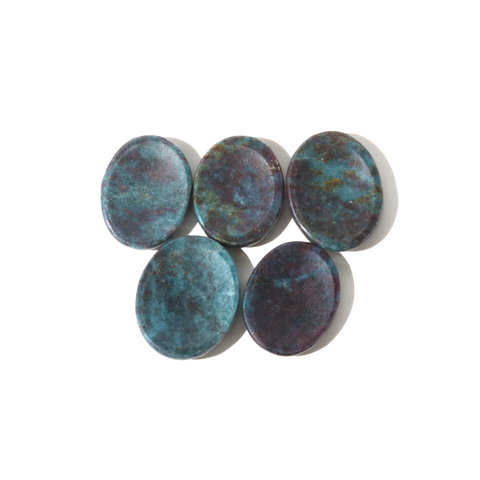


Kyanite: the crystal with two hardnesses
Scratch it one way and a steel knife marks it. Turn it sideways and the same knife slides off.
Kyanite is an aluminium silicate that grows as long, flat blades. Its name comes from the Greek kyanos, dark blue, and blue is the colour most people know. The colour is often patchy, deeper in streaks down the middle of a blade and paler at the edges.
It is famous among mineralogists for one odd property. Along the length of a blade it is only about 4.5 to 5 on the Mohs scale, so a steel point will scratch it. Across the blade it is 6.5 to 7, as hard as quartz. Very few minerals change hardness this much with direction, and old texts called it disthene, meaning two strengths.
Kyanite forms deep in the crust, where rock is squeezed under high pressure. Geologists use it as a pressure gauge for the rocks it sits in. Industry uses it too. Heated, it turns into mullite, a tough material for kiln parts and spark plug insulators.
For a shop, the blades are the hook. They catch the light like brushed metal, they are light to ship by the bag, and the clusters look dramatic on a shelf. The catch is that kyanite splits easily along the blade, so it needs gentle handling and good packing.
Along the blade a knife scratches it. Across the blade it is as hard as quartz.


