


Labradorite: a Canadian stone with a hidden flash
Hold it one way and it is grey rock. Tilt it a few degrees and the whole face lights up blue.
Labradorite takes its name from Labrador, in Canada, where it was described from Paul's Island near Nain in the 1770s. Moravian missionaries sent pieces back to Europe, and the flashing stone became a fashion. For a Canadian shop, that is a story worth telling at the counter.
It is a plagioclase feldspar, part of a mineral series that runs from sodium-rich albite to calcium-rich anorthite. Labradorite sits in the middle. As it cooled, it separated into very thin alternating layers of slightly different composition, stacked like the pages of a book.
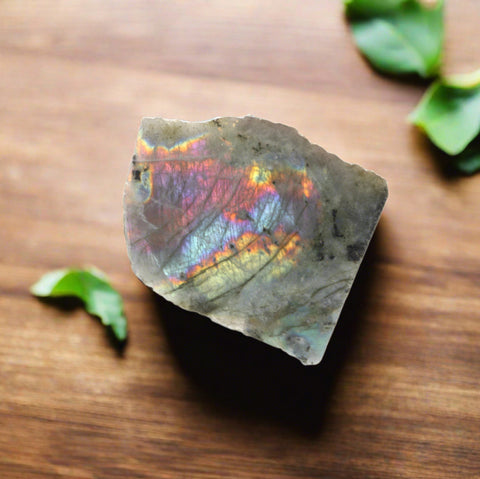
Light that enters those layers bounces between them, and some colours are reinforced while others cancel out. The result is labradorescence, a flash of blue, green, gold or orange that appears only at certain angles. The thickness of the layers sets the colour, which is why one stone can show blue in one patch and gold in the next.
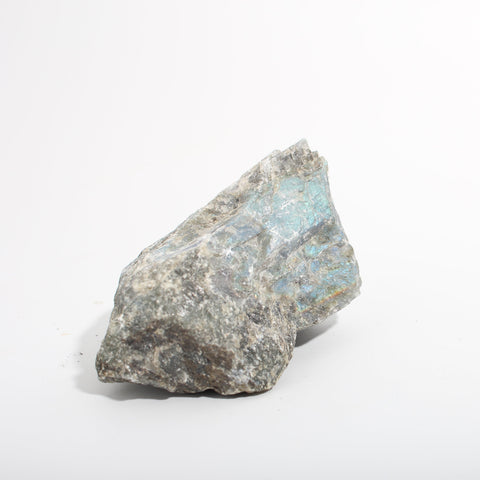
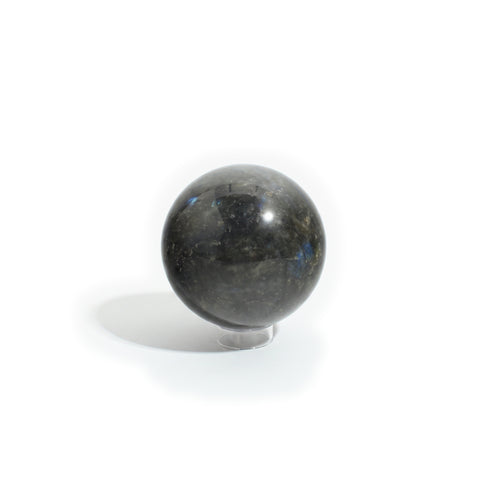
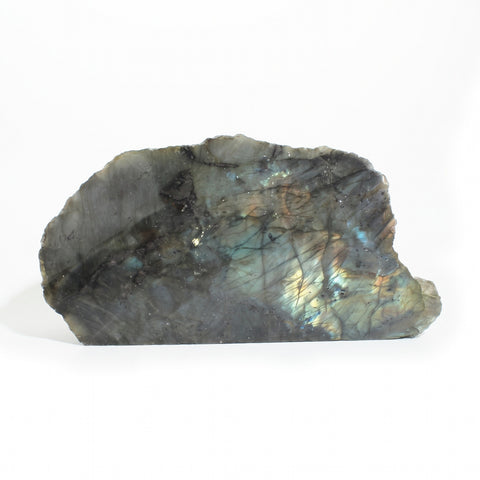
That is also why labradorite is polished so often. A rough chunk can look like plain grey rock until a polished face is turned to the light. Top-polished slices keep the natural edges and polish one face, so a buyer gets both the raw stone and the flash. Very high-grade labradorite from Finland, with a black body and full-spectrum colour, is sold as spectrolite.
The flash is not a pigment. It is light bouncing between layers far thinner than a hair.